FY2026-2026 Grassroots Subgrant documents are currently being edited and will be available soon. For questions and information please call 336 629-0399.
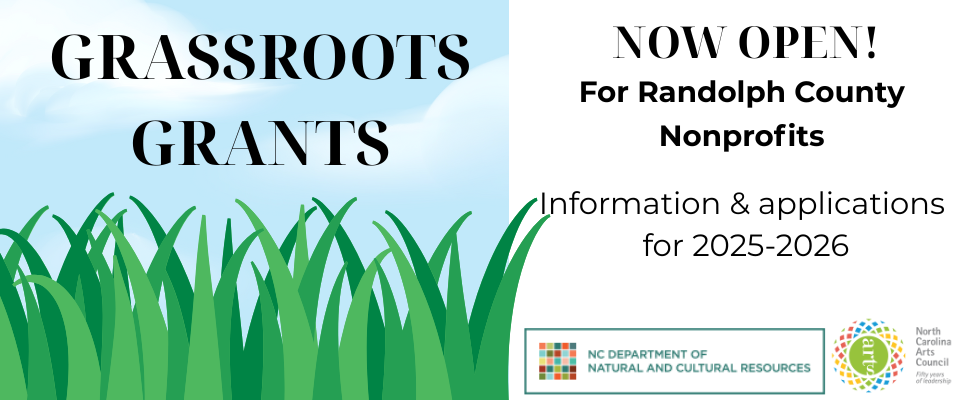
What the Grassroots Arts Program Funds
Since 1977, the North Carolina Arts Council’s Grassroots Arts Program (GAP) has provided North Carolina citizens access to quality arts experiences. The program distributes funds for the arts in all 100 counties of the state primarily through partnerships with local arts councils.
You do not have to be an arts-based non-profit organization to apply, but your program must focus on arts-based activities. All organizations applying must reside and carry out projects within Randolph County. This grant does not distribute funds to individual artists.
Grassroots Arts Program funds may be used for expenditures to conduct quality arts programs. Typical uses of Grassroots money include:
Program expenses such as professional artists’ fees, artists’ teaching fees, arts education programming, multicultural art programming and experiences, space rental, advertising, marketing and publicity, scripts, costumes, sets, props, music and equipment rental.
- Limited operating expenses for arts organizations only. Organizations receiving N.C. Arts Council Sustaining Support funding are not eligible to receive GAP subgrant funding.
Subgrant Application deadline has been extended.
(While the initial deadline has passed, applications will be review and accepted until April 2026, funds are limited and all applicants are encouraged to submit as soon as possible)
Please Read and Follow the Following Guidelines
Eligibility and Qualified Expenditures
Eligibility
- Organizations must have been in operation for at least one year to be eligible to receive a subgrant. While nonprofit 501(c)(3) status is preferred, organizations that are nonprofit in nature may also receive Grassroots Arts Program Grassroots partners may require unincorporated nonprofits to have a fiscal agent to receive the funds on their behalf.
- The Grassroots Arts Program legislation requires that the grant be matched dollar for dollar with cash from local sources during the applicable fiscal year. Neither Grassroots allocations nor the matching funds may be used to match any other N.C. Arts Council grant
- All organizations must reside and carry out projects within the county they are applying for funds (Randolph)
- All projects must take place between July 1, 2025 and June 30, 2026.
- Grant amounts range from $500 and up.
- Funding may be awarded in part, in full or not at all through the discretion of the Grassroots Advisory Committee, see “Funding Priority and Evaluation” below
- Only complete applications received by the due date will be
- Subgrants may not be awarded to arts organizations that already receive operating support directly from the N.C. Arts Council
What the grant will fund
- Program expenses for projects of high artistic merit including artist fees and travel, space rental, marketing, advertising, costumes, sets, props, and equipment rental.
- Limited operating expenses for arts organizations
Examples of arts programs that are commonly supported with Grassroots funds are:
- Performances
- Festivals
- Art exhibitions
- Arts camps and after-school programs
- Artist residencies for K-12 schools
- Artist fees for classes and workshops
- Marketing expenses for art walks and studio tours
- Royalties, props, sets, and costumes for theater performances
- Equipment rental for arts programming
- Space rental for arts programming
Grassroots Arts Program Unqualified Expenditures
Grassroots Arts Program money may not be used for the following kinds of expenditures:
• Prizes, competitions, scholarships, tuition, or financial awards
- Art supplies or equipment purchases
- Fundraising events
- Purchase of artwork
- Food or beverages for hospitality or entertainment functions
- Capital expenditures
- Internal school programs such as band activities or equipment or choral activities
- Oral history and history projects
- Interest on loans, fines, or litigation costs
- Transportation cost
- Artifacts
- Contingency funds
- Deficit reduction
- Food or beverages for hospitality or entertainment functions
- School band equipment
- School choral activities
- Lobbying expenses
- Oral history and history projects
- Tuition for academic study
Additional Policies
Additional funding policies
1 Tribal organizations that receive Grassroots funds must represent state or federally recognized tribes. North Carolina’s state-recognized tribes are Coharie Tribe, Eastern Band of Cherokee, Haliwa-Saponi Tribe, Lumbee Tribe, Meherrin Tribe, Occaneechi Band of Saponi Nation, Sappony Tribe, and the Waccamaw Siouan Tribe. An approved list of tribes can be found at www.doa.nc.gov/divisions/american-indian-affairs/nc-tribes.
2. Colleges, universities, and libraries may receive grants for arts programs that are community- based or generate regional arts involvement. Grants may not support their internal programs, administration, or operating expenses (e.g., library books, band activities, equipment purchases).
3. Religious organizations or churches may not receive Grassroots funds unless the programs are presented outside regular church services, engage the larger community, and do not contain religious content.
4. Grassroots funds may not be used for activities associated with a school’s internal arts programs, such as in-school student performances, the purchase of art supplies, or student arts competitions and publications.
5. Grassroots funds may be used for student transportation to regional arts exhibits and programs on a limited basis. Prior approval from the Arts in Communities director is required, and documentation of the expense must be included in the organization’s final report.
6. Municipalities (city/county government) and community organizations may receive grants for arts programs that use qualified artists to conduct programs that involve the greater community. Grants may not support internal programs, administration, or operating
7. Because the N.C. Symphony is a state agency and receives state funds, including funds specifically for its touring and education programs, no Grassroots funds may be granted to the C. Symphony or the N.C. Symphony Foundation or to pay for performances or education programs of the N.C. Symphony.
Funding Priority and Evaluation
Community representation
To ensure that Grassroots-funded arts programs are representative of our state, a percentage of the grant must be used in a way that reflects every part of the partner’s community. This requirement is met through supporting arts programming conducted by artists, ensembles, or organizations that are representative of the community; not by counting or estimating the percentage of audience members or participant representation. The organization does not have to be an arts organization, but the funds must be used for arts programming.
Priorities for funding
- The first priority of the Grassroots Arts subgrant program is to provide program support to qualified arts organizations not already receiving or eligible to receive support from the N.C. Arts Council. These include theaters, symphonies, galleries, art guilds, choral societies, dance companies, folk arts societies, writers’ groups and arts festivals, among others.
- The second priority of the Grassroots Arts subgrant program is to support arts learning and arts in education programs conducted by qualified artists. These can be artist residencies in schools, after school or summer camps or adult arts learning classes. The third priority of Grassroots Arts subgrants is to community, civic and municipal organizations. These programs must be conducted by qualified artists.
- Applicants that support community, civic, and municipal organizations that provide high-quality arts experiences for the greater community. These programs must be conducted by qualified
In an effort to advance diversity, equity, and inclusion, preference will be given to organizations whose projects engage multicultural artists and communities.
Criteria for evaluation
A local panel of volunteers will adjudicate the Grassroots Applications based on the following criteria:
- Artistic quality of the proposed project
- Community impact of project or program
- Ability to plan and implement project
- Stability and fiscal responsibility of the organization
Grassroots Subgrant Requirements
Requirements of the Grassroots Grant
Matching funds
The Grassroots Arts Program legislation requires that the grant be matched dollar for dollar with cash from local sources during the applicable fiscal year. Neither Grassroots allocations nor the matching funds may be used to match any other N.C. Arts Council grant. All matching funds must be documented as part of the final report for the grant at the end of the fiscal year.
North Carolina Arts Council logo usage
All subgrant recipients are required to prominently display the North Carolina Arts Council logo with tagline and credit lines on-site at funded events and in all digital and printed publicity materials including websites, electronic newsletters, and in as many materials and places as possible. To access the N.C. Arts Council logo and branding materials, visit https://www.ncarts.org/grants- resources/resources/logo-branding-materials
Randolph Arts Council Logo Use
All subgrant projects must also recognize and credit the Randolph Arts Council along side the NCAC logo and tagline (logos included in award packet)
Legislative Letters
Applicants may be required to write their state representatives to thank them for appropriating Grassroots funds. If required, the letter should provide information about how Grassroots funds were used to support your program or project, and the community impact of the event. A copy of all letters to legislators must be included in the final report materials.
Reporting and documentation requirements
Subgrant awardees must complete a final report to document the use of the funds, share participant statistics and demographics, provide verification of matching funds and demonstrate examples of the use of the N.C. Arts Council’s logo and credit line. Subgrantees must also submit a No Overdue Tax Form.
Subgrant Application PDF
Subgrant Application Submission & Information Meetings
Subgrant Applications can be submitted to the Randolph Arts Council via email (roselonguillo@randolphartsguild.com) or delivered in person to 123 Sunset Ave Asheboro NC, 27203 (Wed-Fri 11am-5pm).
For applicants wishing to know more about the grassroot process or for a step by step presentation on how to complete the application please join us for the Grassroot Subgrant secessions on Wednesday November 12th (5pm-6pm) and Friday November 14th (1pm-2pm).
Meetings will be held via zoo, email Rose Longuillo (roselonguillo@randolphartsguild.com) or call 336.629.0399 to RSVP and receive the zoom link for your intended meeting time.